

How to Dial In Espresso for Beginners
Table of Contents
- What It Means to Dial In Espresso
- Understanding the Espresso Brew Ratio Explained
- How to Adjust Espresso Grind Size
- Troubleshooting Sour vs Bitter Espresso
- Shot Timing and Flow Rate
- The One Variable at a Time Method
- Essential Equipment for Beginners
- Common Mistakes to Avoid When Dialing In
- Frequently Asked Questions
Last Updated: October 4, 2026
What It Means to Dial In Espresso
Dialing in espresso is the process of adjusting your grinder, dose, and tamp to achieve optimal extraction. It's how you move from random shots to consistent, delicious espresso that tastes the way you want it to taste.
When you dial in espresso, you're solving a specific problem: water flows through ground coffee at different rates depending on how fine the grounds are, how tightly they're packed, and how much coffee you're using. Get these variables wrong and you end up with shots that taste sour, bitter, thin, or muddy. Get them right and you unlock the full flavor potential of your beans.
At The Good Beanery, as specialty coffee roasters, beans are roasted the day they're sent to you. That freshness matters enormously when you're dialing in. Fresh beans extract more predictably and reveal more complexity in the cup. But even with excellent beans, dialing in is non-negotiable if you want repeatable results.
The good news: dialing in isn't mysterious. It follows a logical sequence, and once you understand the fundamentals, you can troubleshoot almost any extraction problem.
Understanding the Espresso Brew Ratio Explained
The espresso brew ratio is the relationship between the weight of dry coffee going into your portafilter and the weight of liquid espresso coming out. Most specialty espresso uses a 1:2 ratio, meaning if you put 18 grams of coffee in, you're aiming for roughly 36 grams out.
This ratio matters because it directly influences how much soluble coffee material ends up in your cup. A tighter ratio (like 1:1.5) produces a shorter, more concentrated shot. A looser ratio (like 1:3) produces a longer, lighter shot with more water contact time.
The 1:2 ratio has become standard for good reason: it balances extraction time, flavor intensity, and the practical realities of home equipment. Most shots at this ratio finish in 25-30 seconds, which gives you a reasonable window for dialing in without requiring split-second timing.
Starting point: weigh your basket size (usually printed on the side), then aim for double that weight in the cup. If your basket holds 18 grams, target 36 grams out. Use a small kitchen scale for consistency.
How to Adjust Espresso Grind Size
Grind size is your primary lever for controlling extraction speed and evenness. Finer grounds slow water flow and increase contact time. Coarser grounds speed water flow and decrease contact time.
When you're dialing in espresso, grind size adjustments are usually your first move. If your shot runs too fast (under 20 seconds), go finer. If it runs too slow (over 35 seconds), go coarser. Move in small increments, most grinders have dozens of settings between "too fast" and "too slow."
The Role of Grind Size in Extraction
Grind size directly determines how quickly water moves through the coffee bed. Smaller particles create more surface area and more resistance to water flow. This extended contact time extracts more soluble material from the grounds.
The relationship is straightforward: finer grind = slower flow = longer shot time = more extraction. Coarser grind = faster flow = shorter shot time = less extraction.
But here's where it gets practical: you're not just adjusting for time. You're adjusting to achieve balanced extraction. A shot that runs in 28 seconds with even flow looks and tastes different from a shot that runs in 28 seconds with channeling (water finding paths of least resistance through the puck). The grind size influences both the speed and the evenness.
Adjusting Dose and Yield
Dose is the amount of dry coffee you put into the basket. Yield is the amount of liquid espresso you get out. Together, they define your brew ratio and influence your extraction.
Increasing your dose means more coffee in the basket, which increases resistance to water flow and slows your shot down. Decreasing your dose does the opposite. This is your secondary adjustment after grind size.
Most beginners start with their basket's stated capacity (usually 18-20 grams for a double basket) and keep it consistent. Once you dial in at that dose, you can experiment with higher or lower doses to adjust flavor intensity.
The yield is what you measure in the cup. Stick to your target ratio, if you're running 1:2 with an 18-gram dose, you're looking for 36 grams out, regardless of whether that takes 25 seconds or 30 seconds.
Troubleshooting Sour vs Bitter Espresso
Sour and bitter shots tell you that your extraction is unbalanced. Understanding which one you're tasting tells you which direction to adjust.
Identifying Sour Flavor Profiles
Sour espresso tastes tart, acidic, or sharp. It's under-extracted, water didn't spend enough time pulling soluble material from the grounds. The shot finishes too quickly, or the flow is uneven, or both.
Visual clue: a sour shot often has a thin, watery appearance with little to no crema. The liquid comes out too fast and leaves too much flavor potential in the puck.
Fix: make your grind finer to slow the flow, or increase your dose to add more resistance. Aim for a shot time between 25-30 seconds. If your shot is already in that window but tastes sour, channeling is your problem, water is taking shortcuts through the puck instead of flowing evenly through all the grounds.
Identifying Bitter Flavor Profiles
Bitter espresso tastes harsh, burnt, or overly intense. It's over-extracted, water spent too much time pulling soluble material, including undesirable compounds that taste harsh.
Visual clue: a bitter shot often has heavy, dark crema and flows very slowly. The liquid comes out thick and syrupy.
Fix: make your grind coarser to speed the flow, or decrease your dose to reduce resistance. If your shot is already running quickly but still tastes bitter, your puck preparation or tamping is creating uneven density, causing some areas to extract too much while others extract too little.
Shot Timing and Flow Rate
Shot timing, how long water takes to travel through your grounds, is your window into what's happening inside the basket. A proper shot typically runs 25-30 seconds from the moment you start the pump until you stop it (Checking your browser).
This timing matters because it correlates with extraction. Too fast (under 20 seconds) and you're under-extracting. Too slow (over 35 seconds) and you're over-extracting. The sweet spot is usually in that 25-30 second window, but the exact timing depends on your grind size, dose, and how tightly you've tamped.
Flow rate, how fast the liquid comes out, tells you about puck density and evenness. Smooth, steady flow suggests good packing and tamping. Sudden gushing or sputtering suggests channeling or uneven density.
Watch your first few shots. If espresso starts flowing immediately and finishes in 15 seconds, your grind is too coarse or your dose is too low. If nothing comes out for 10 seconds then suddenly gushes, your grind is too fine or your dose is too high.
The One Variable at a Time Method
This is the methodology that separates successful dialing in from endless frustration. Change one variable, pull a shot, evaluate, then decide on your next adjustment.
If you change your grind, your dose, and your tamp all at once, you have no idea which change caused which result. You'll chase your tail endlessly.
The sequence: grind size first (this has the biggest impact on flow rate), then dose (this fine-tunes resistance), then tamp pressure and puck preparation (these influence evenness). Pull a shot after each change. Taste it. Look at the flow. Time it. Then make your next decision based on what you observed.
This approach takes patience, but it's the only way to actually learn what each variable does. After a few sessions, you'll develop intuition about how to read a shot and know immediately what needs adjusting.
Essential Equipment for Beginners
You need three things to dial in espresso properly: a burr grinder, a scale, and a way to time your shots.
A burr grinder is non-negotiable. Blade grinders produce inconsistent particle sizes, which makes dialing in impossible. Burr grinders (either flat or conical burrs) produce uniform grounds.
A scale that measures to 0.1 grams is essential. You're measuring both your dry dose going in and your liquid yield coming out.
A timer (your phone works) helps you track shot time. This data point tells you whether your grind adjustment is moving in the right direction.
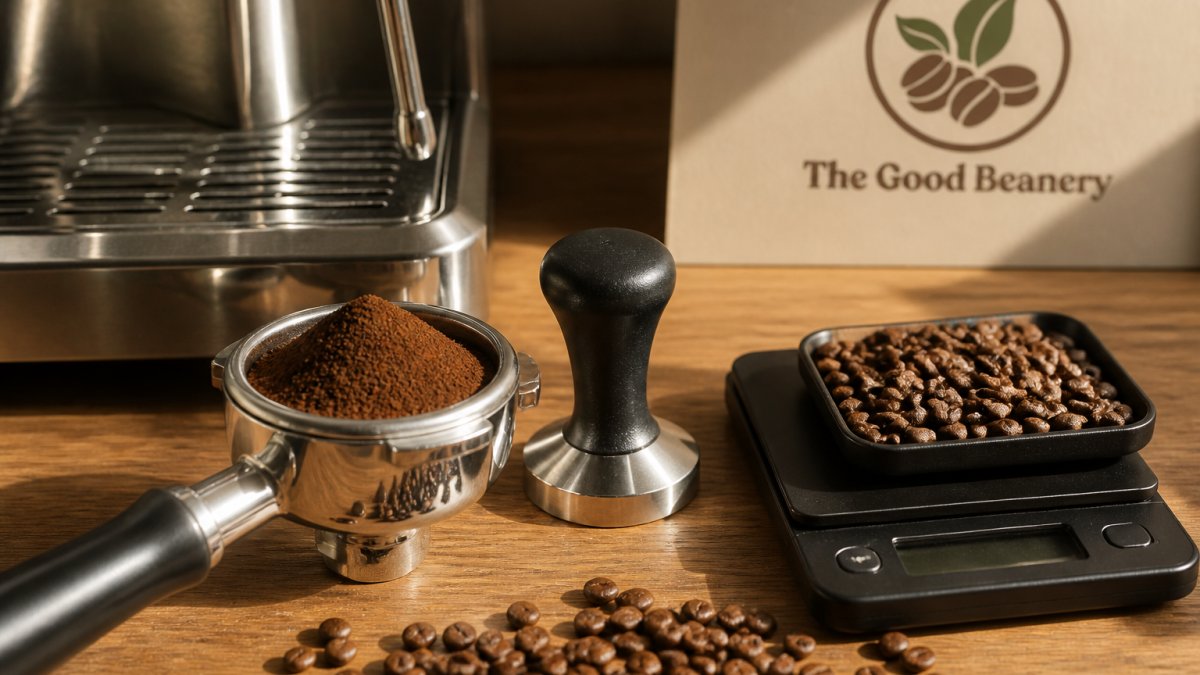
Beyond these three, you'll benefit from The Good Beanery's specialty-grade beans roasted the day they ship. Our African Espresso blend and 6 Bean Blend are both designed for espresso extraction and dial in consistently across different machines.

Common Mistakes to Avoid When Dialing In
The biggest mistake is changing multiple variables at once. You pull a shot, it tastes bad, so you adjust your grind, increase your dose, and tamp harder. Now you have no idea which change helped or hurt. Avoid doing this.
The second mistake is not using a scale. Eyeballing your dose means your brew ratio drifts between shots. Consistency is impossible without knowing your actual numbers.
The third mistake is expecting dialing in to be fast. Your first shot is almost always wrong. Your second and third are usually still off. By your fifth or sixth shot, you're starting to see patterns. This is normal.
A fourth common issue is channeling, water finding paths of least resistance through the puck instead of flowing evenly. This happens when your grounds aren't distributed evenly in the basket, or when your tamp is uneven, or both.
The fifth mistake is using stale beans. Beans older than three weeks start losing complexity and become harder to dial in predictably.
Dialing in espresso is a skill that compounds. Your first session will feel uncertain. Your tenth session will feel routine.
Start with fresh, quality beans. The Good Beanery's specialty-grade coffees are roasted for extraction clarity, which means the feedback you get during dialing in is honest and actionable. Start with our 6 Bean Blend or African Espresso, both dial in consistently and reward attention to technique with genuinely excellent shots.
Frequently Asked Questions
What is the 10 second rule for espresso?
The 10 second rule refers to the initial pre-infusion phase when water first contacts the coffee puck. During this time, the water saturates the grounds evenly before full pressure builds. This helps prevent channeling and ensures uniform extraction. Once you reach 10 seconds, full pump pressure engages and your shot timing begins. Proper pre-infusion is critical for consistent results.
How much coffee should I use for a double shot espresso?
A standard double shot uses 18-20 grams of ground coffee in a double basket. The exact amount depends on your specific machine and basket size. Start with 18 grams and adjust based on your yield target. Most double shots aim for 36-40 grams of liquid espresso output. Use a scale to measure both your dose and yield precisely, as this is the foundation of dialing in espresso.
Why does my espresso taste sour or bitter?
Sour espresso indicates under-extraction: the water passes through the grounds too quickly, pulling out acidic flavors before reaching sweeter compounds. Fix this by grinding finer, using more coffee, or tamping harder. Bitter espresso signals over-extraction: water stays in contact with grounds too long, pulling out harsh compounds. Solve this by grinding coarser, using less coffee, or reducing shot time. Adjust one variable at a time to identify the cause.
What equipment do beginners actually need to dial in espresso?
You need an espresso machine with a portafilter, a burr grinder (essential for consistency), a kitchen scale accurate to 0.1 grams, and a tamper. A timer helps you track shot time. A tasting wheel or cupping spoon helps you identify flavor notes. While some machines include basic grinders, a separate burr grinder makes dialing in far easier. Quality beans matter too—freshly roasted specialty grade coffee like those from The Good Beanery, roasted the day they ship, gives you the best starting point.